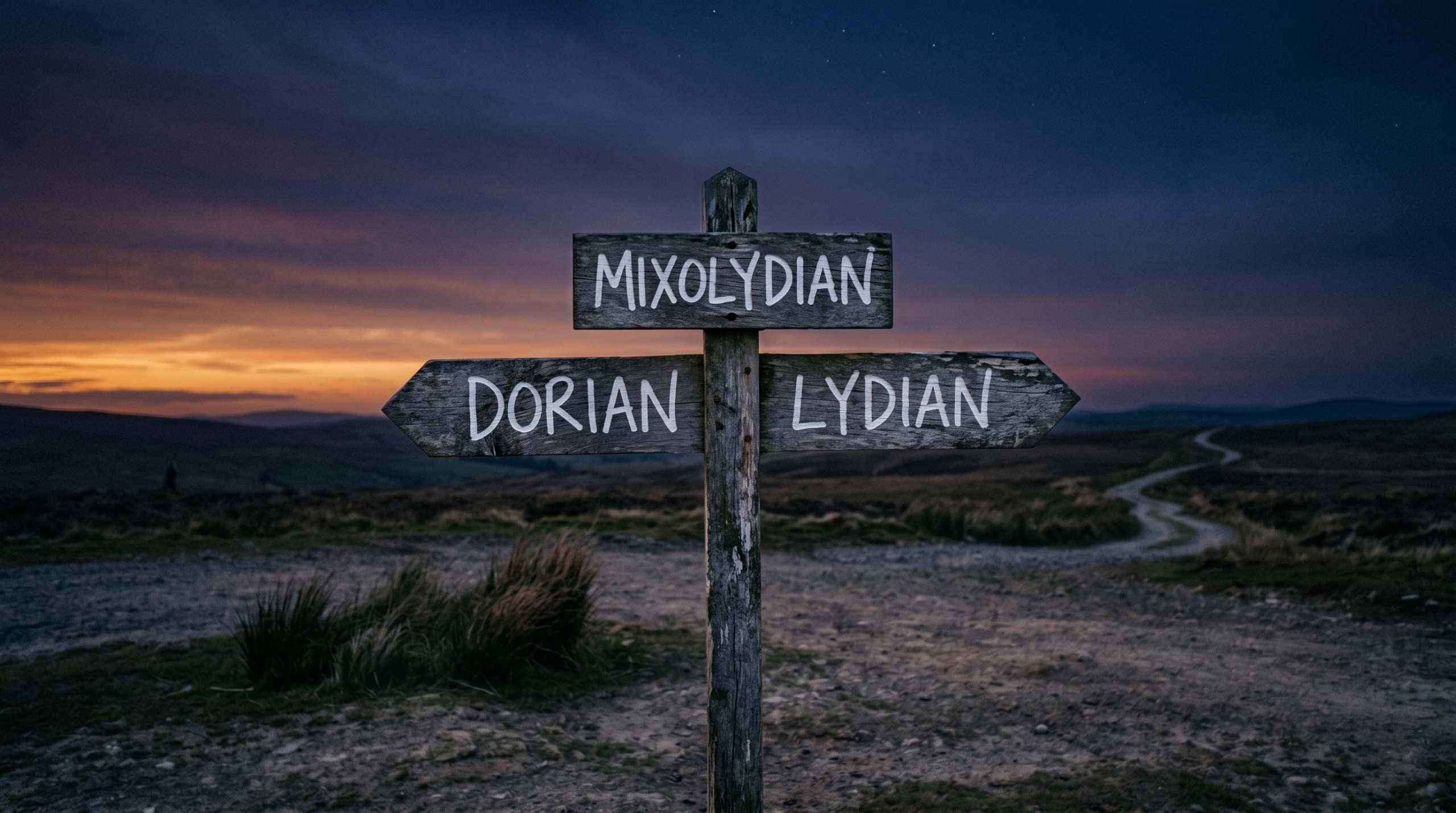
Every guitarist reaches the modes eventually. Usually it goes something like this: you’re getting comfortable with the pentatonic scale, someone mentions modes, you look them up, and suddenly you’re staring at seven scales with Greek names, a parent scale system that makes no intuitive sense, and the nagging feeling that everyone else has figured this out except you.
Most of them haven’t. Modes have a reputation for being complicated that’s almost entirely the fault of how they’re taught — not the modes themselves.
Here’s the thing nobody tells you upfront: you don’t need all seven modes. Not to start with, and arguably not ever, depending on what you play. Most real-world musical situations are covered by three. Learn those three well and you’ll have more harmonic vocabulary than the majority of guitarists you’ll ever play with.
First — a quick word on what modes actually are
Modes are scales. Specifically, they’re the seven scales you get when you start the major scale from each of its seven notes. Start from the first note and you get Ionian (the major scale itself). Start from the second and you get Dorian. From the third, Phrygian. And so on.
That’s the theory in one paragraph. Most explanations spend twenty pages on it because they’re trying to be comprehensive. Comprehensive is the enemy of useful.
The more important question is what each mode sounds like and what you play it over. That’s what actually matters when you’re holding a guitar.
The three modes worth learning first
1. Dorian
Dorian is the minor mode. It’s built from the second degree of the major scale and has a minor quality with one crucial difference from the natural minor scale — it has a natural 6th rather than a flat 6th, which gives it a slightly brighter, bluesier quality.
In practice: play Dorian over minor chords, minor 7 chords, and minor chord progressions. It’s the sound of Carlos Santana, Robben Ford, the verses of Oye Como Va, the intro of Riders on the Storm. If you play rock, blues or funk, Dorian is the most useful scale on the guitar. Full stop.
The shortcut: if you already know the minor pentatonic, you already know most of Dorian. Add the 2nd and 6th to your minor pentatonic and you’re there. Two extra notes, an enormous upgrade in harmonic vocabulary.
2. Mixolydian
Mixolydian is the dominant mode — the major scale with a flat 7th. It has a major quality but with a slight tension that makes it perfect for dominant seventh chords, blues-rock progressions, and anything with a V chord that lingers rather than resolving.
In practice: play Mixolydian over dominant 7th chords (G7, A7, E7, etc.) and dominant chord progressions. It’s the sound of classic rock — Sweet Home Chicago, Norwegian Wood, virtually everything in the Chuck Berry and early Stones catalogue. Any blues-rock player who wants to sound more sophisticated without going near jazz needs Mixolydian.
The shortcut: Mixolydian is the major pentatonic scale with two added notes — the 4th and the flat 7th. Again, something you probably already have partially under your fingers.
3. Lydian
Lydian is the bright, floating, slightly otherworldly major mode — the major scale with a raised 4th. That single raised note gives Lydian its distinctive sound: open, dreamy, slightly outside. It’s the sound Joe Satriani built a career on, the sound of film scores when something magical is supposed to be happening.
In practice: play Lydian over major 7th chords and major chord progressions where you want something more interesting than straight major. It’s less immediately useful than Dorian or Mixolydian for most guitarists but once you hear it you’ll recognise it everywhere — and once it’s under your fingers you’ll use it constantly.
The shortcut: Lydian is the major scale with one note raised. If you know your major scale or major pentatonic, you’re a single semitone adjustment away.
What about the other four?
Ionian (the major scale) and Aeolian (the natural minor scale) you almost certainly already know — they just go by different names in a modal context. They’re worth understanding as modes but you’re not learning anything new to add them to your vocabulary.
Phrygian has a Spanish, flamenco quality that’s distinctive and worth knowing if that’s a sound you want. It’s less universally applicable than the first three but not difficult once Dorian and Mixolydian are solid.
Locrian is theoretically complete but practically almost unused — it’s built on the diminished chord and resolves restlessly in a way that makes sustained improvisation over it difficult. Learn it when you’ve exhausted everything else.
How to actually get them into your playing
Knowing what a mode is and being able to use it are different skills. The theory takes an afternoon. The fretboard application takes longer — but much less time than most people assume if you go about it the right way.
The mistake is trying to learn new scale patterns for each mode from scratch. You don’t need to. Start from what you already know — your pentatonic and major scale positions — and add the two or three missing notes that define each mode. That’s a much shorter path than learning seven new scale systems.
Once the notes are under your fingers, practice each mode over a drone or a looped chord. Not a backing track with lots going on — just the root chord, on repeat, while you find the sound of the mode. This is how you develop the ability to hear Dorian or Mixolydian rather than just play the right notes.
Free resource — before you go
If modes are still feeling abstract and you want the clearest, most concise overview I know how to give: Modes on Guitar for People in a Hurry is a free PDF that covers the essential theory in a single sitting. No sign-up required.
Ready to go deeper?
Once the three core modes are making sense, here’s where to go next:
Quickstart Guides: Modes — the theory covered properly, concisely, and connected directly to the fretboard. Available on Kindle and as a PDF.
The Dorian Improvisation System — if Dorian is the mode you want to master first (and it probably should be), this book builds a complete improvisational framework around it. 100+ diagrams, works across rock, blues, funk and jazz fusion.
Major Scale Modes Designed for the Guitar — once the theory is clear, this book maps every mode across the entire neck from any root note. The fretboard companion.
Modes and How to Use Them — the full treatment: hearing modes, modes as scales in their own right, modes over chord progressions, creating modal chord progressions. Available on Kindle.