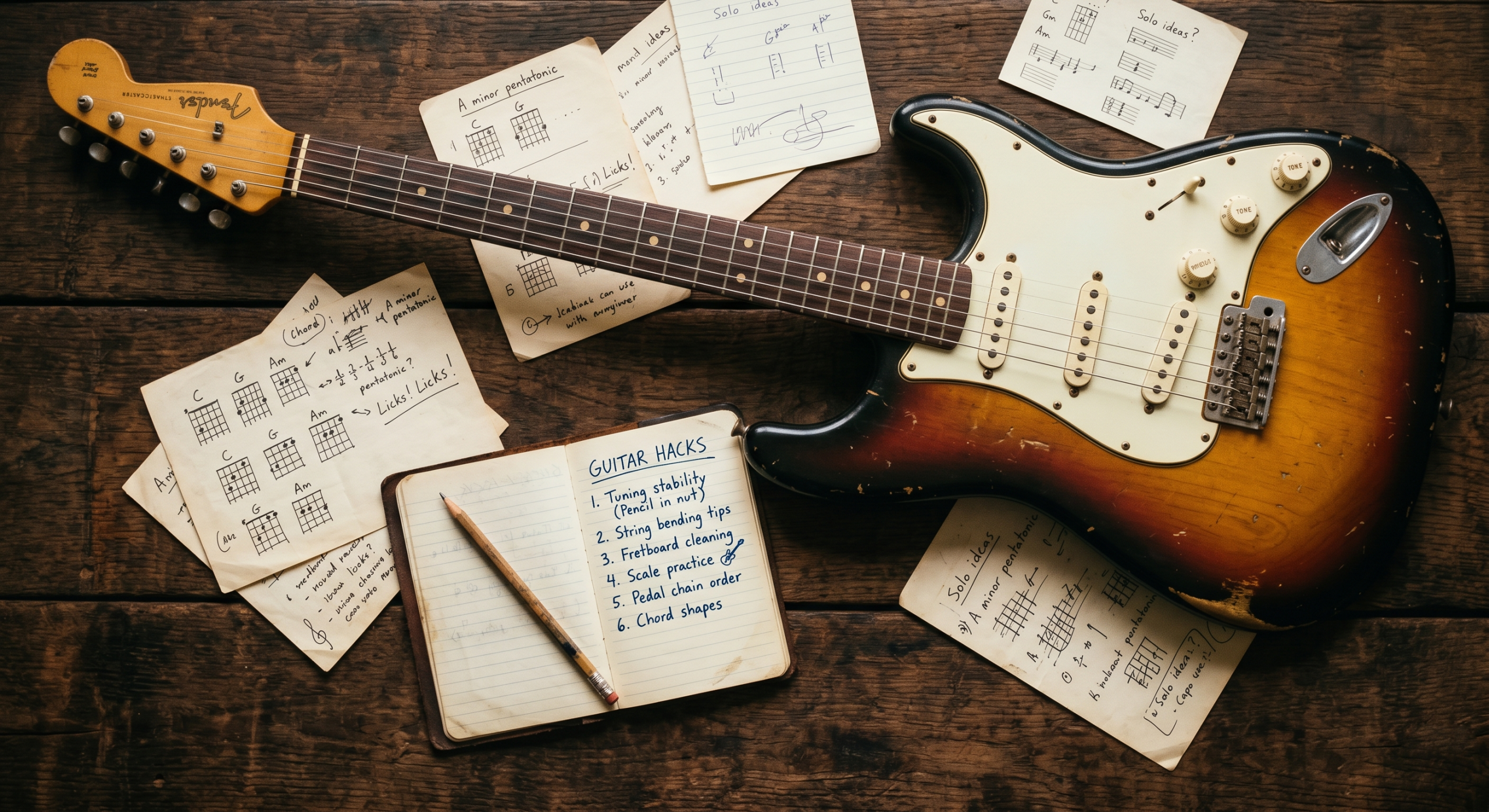
Most “guitar hacks” articles are about gear maintenance — pencil graphite in the nut slots, toothpicks in screw holes, that kind of thing. Useful, but not what this is.
These 25 hacks are about playing better, thinking more clearly about the instrument, and getting more out of every practice session. They’re drawn from 20+ years of playing, teaching, and figuring out what actually works — the same thinking behind the Guitar Hacks book series.
Work through them in order or jump to whatever’s most relevant right now.
Fretboard Hacks
1. Learn two positions per scale instead of five or seven. Most scale systems hand you five or seven patterns and send you off to memorise them all before anything becomes useful. The 2 Position Guitar Scale System cuts that to two positions per key — the same fretboard coverage, about 80% less to learn before you’re actually playing.
2. Use one scale pattern to solo over multiple keys. You don’t need a different pattern for every key. One scale shape, moved to the right position on the neck, works across all 12 keys. This lesson shows you exactly how.
3. Derive your arpeggios from your scales — don’t learn them separately. Most guitarists treat scales and arpeggios as two completely separate things to learn. They’re not. Unlock arpeggio patterns using your existing scales and you halve the learning overhead instantly.
4. Use the adjacent string trick. Whatever you play on strings one and two, you can replicate on strings three and four, and strings five and six. This simple insight immediately doubles and triples the fretboard territory you have available without learning anything new.
5. Stop thinking in boxes — think in intervals. Breaking out of scale boxes isn’t about learning more patterns — it’s about understanding the intervals between notes and using them to move freely across the neck rather than staying inside a shape.
6. Use open position for sounds closed voicings can’t produce. The first few frets of the guitar in standard tuning contain voicings that simply don’t exist anywhere else on the neck. 184 open chord voicings proves this point comprehensively.
Scales & Improvisation Hacks
7. Start blues soloing with Mixolydian, not the blues scale. The minor pentatonic and blues scale are the obvious starting points for blues, but starting with Mixolydian gives you a more harmonically sophisticated sound immediately — and it sits naturally over dominant seventh chords in a way the blues scale doesn’t always manage.
8. Use pentatonics as a gateway to modes, not a replacement for them. Pentatonics and modes aren’t separate systems. Beyond Pentatonics maps the modes directly onto pentatonic shapes you already know — no reset required.
9. Extend your pentatonic beyond the box. If you’re stuck playing the same pentatonic box, extended pentatonic scales show you how to connect positions and cover the whole neck without abandoning the scale that already works for you.
10. Stop trying to learn all seven modes at once. The reason most guitarists struggle with modes isn’t a lack of ability — it’s the approach. Trying to learn all seven in one go is the problem. Start with one, apply it musically, and build from there.
11. Add intervallic leaps to avoid linear, predictable solos. Playing up and down a scale in a linear fashion is the most common cause of boring, mechanical solos. Intervallic leaps are one of the fastest ways to make lines sound more musical and individual.
12. Use the melodic minor for instant sophistication over dominant chords. The melodic minor scale is how players like John Scofield and Mike Stern get those outside, sophisticated sounds. Break into the melodic minor and you immediately have harmonic options the major scale can’t provide.
13. Learn chord tones and target them when soloing. Chord tone soloing isn’t just for jazz players. Knowing which notes belong to the underlying chord — and landing on them at the right moment — is what separates solos that sound musical from solos that just sound like scale runs.
Practice Hacks
14. Upgrade your posture before anything else. Most guitarists spend years upgrading instruments, pedals and amps but never upgrade the one tool they use every single day. This is the guitar hack no one talks about — and it makes an immediate, measurable difference to timing and feel.
15. Practice guitar while watching TV. It sounds counterintuitive, but practicing rhythm guitar in front of the TV — where the distraction forces you to rely on feel rather than concentration — is one of the most effective ways to internalise timing and build speed.
16. Focus on deliberate practice, not just time on the instrument. Putting in hours isn’t enough if they’re unfocused. The best practice advice is simple: short, completely focused sessions beat long, distracted ones every time.
17. Identify your specific weaknesses and target them directly. 4 tips for avoiding unproductive practice — the most important of which is diagnosing exactly what’s holding you back rather than just running your existing strengths over and over.
18. Practice scales in musical contexts, not just as exercises. 4 world class tips for practicing scales — the key insight being that scales practiced in isolation rarely transfer to real playing. The context matters as much as the repetition.
19. Treat improvisation as a separate skill to learn, not a byproduct of knowing scales. How to practice improvisation — scales, licks and arpeggios are the raw material, but improvisation itself needs to be practiced deliberately. They’re not the same thing.
Mindset Hacks
20. Learn guitar F.A.S.T. — Forget what you think you know, take Action with new concepts, stay Stimulated by what you’re learning, and Teach it to someone else. This framework isn’t a shortcut. It’s a way of structuring your approach so the time you put in compounds rather than evaporates.
21. Understand the 4 levels of awareness. How to get better — the progression from unconscious incompetence to unconscious competence. Knowing which stage you’re at on any given skill changes how you practice it.
22. Challenge yourself radically at least occasionally. 5 radical ways to challenge yourself on guitar — comfort zones are the enemy of progress. Disrupting your routine deliberately, even briefly, forces adaptation in a way steady incremental practice doesn’t.
23. Get out of a scales rut by changing your relationship with patterns, not adding more of them. 3 ways to get out of a scales rut — the rut is almost never about not knowing enough scales. It’s about how you’re using the ones you have.
24. If you hate practicing, change what you practice, not how much. How to practice guitar if you hate practicing — rigid, joyless practice routines are counterproductive. The best practice is the kind you actually do.
25. Your intention matters more than your technique. What you have in mind when you pick up the guitar shapes everything that follows — what you work on, how you focus, whether you make progress or just go through the motions. Most guitarists never make this conscious. The ones who do improve faster.
Want more?
These 25 hacks scratch the surface of what’s in the Guitar Hacks book series — three volumes covering fretboard thinking, technique, creativity and practice in much greater depth.
- 50 Guitar Hacks for the Thinking Man’s Guitarist
- 50 More Guitar Hacks for the Thinking Man’s Guitarist
- 50 Guitar Hacks for the Advancing Guitarist
Or grab one of the free PDFs first to get a feel for the approach.