
I’m constantly looking for more practical ways to learn things on guitar, especially the tedious stuff like scales, arpeggios and triads. Triads are a great place to start but as so often happens, the rote learning of shapes doesn’t always translate to practical use when you want to incorporate them into your playing. In this lesson, we look at a more practical way to learn guitar triads, which is more inline with the way you might use them in a live playing situation.
Guitarists tend to latch onto the triads in the middle of the fretboard, this is probably due to the fact that they fall nicely under your fingers when playing a pentatonic or blues scale. Therefore it makes more sense to start with these guitar triads and work out to edges of the fretboard. Here are the three minor guitar triads in the key of G:

Once you’ve gotten these down, add in the triads on the top three strings as follows. Note that this can be done by adding just one note NOT learning a new shape–there’s a subtle difference.
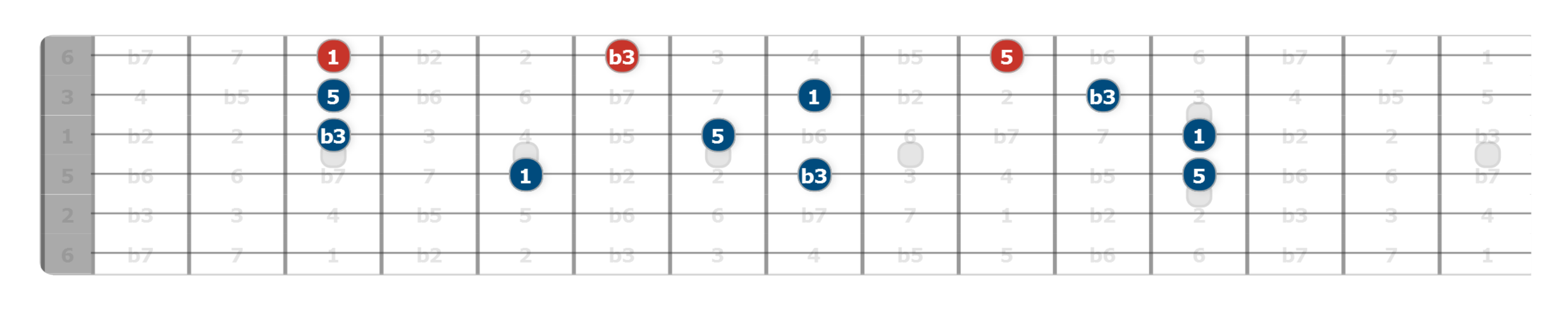
We can also apply the same logic on the other side of the fretboard. Again, just add one note instead of learning a new shape:

This way of thinking about guitar triads when combined with the minor scales you already know becomes a powerful tool for improvising.
We can also do this with the major triads as follows:

Add one note to get the patterns on the top three strings:

And also on the A string:

Combine these triads with the major scales you already know such as the major scale itself, and the Lydian and Mixolydian modes.
This way of thinking about guitar triads — adding notes to existing shapes rather than learning entirely new patterns — is the same principle behind Guitar Hacks: Triads and Inversions, which applies it to all six triad types across the full neck.
Once the triads are under your fingers, How to Make Triad Soloing Work is a four-part series on turning these shapes into actual improvisation tools — including the 4-note cluster method that connects minor, melodic minor and harmonic minor from the same shapes.
And if you want to explore what these triads look like across the Triad Mapper tool: Triad Mapper →