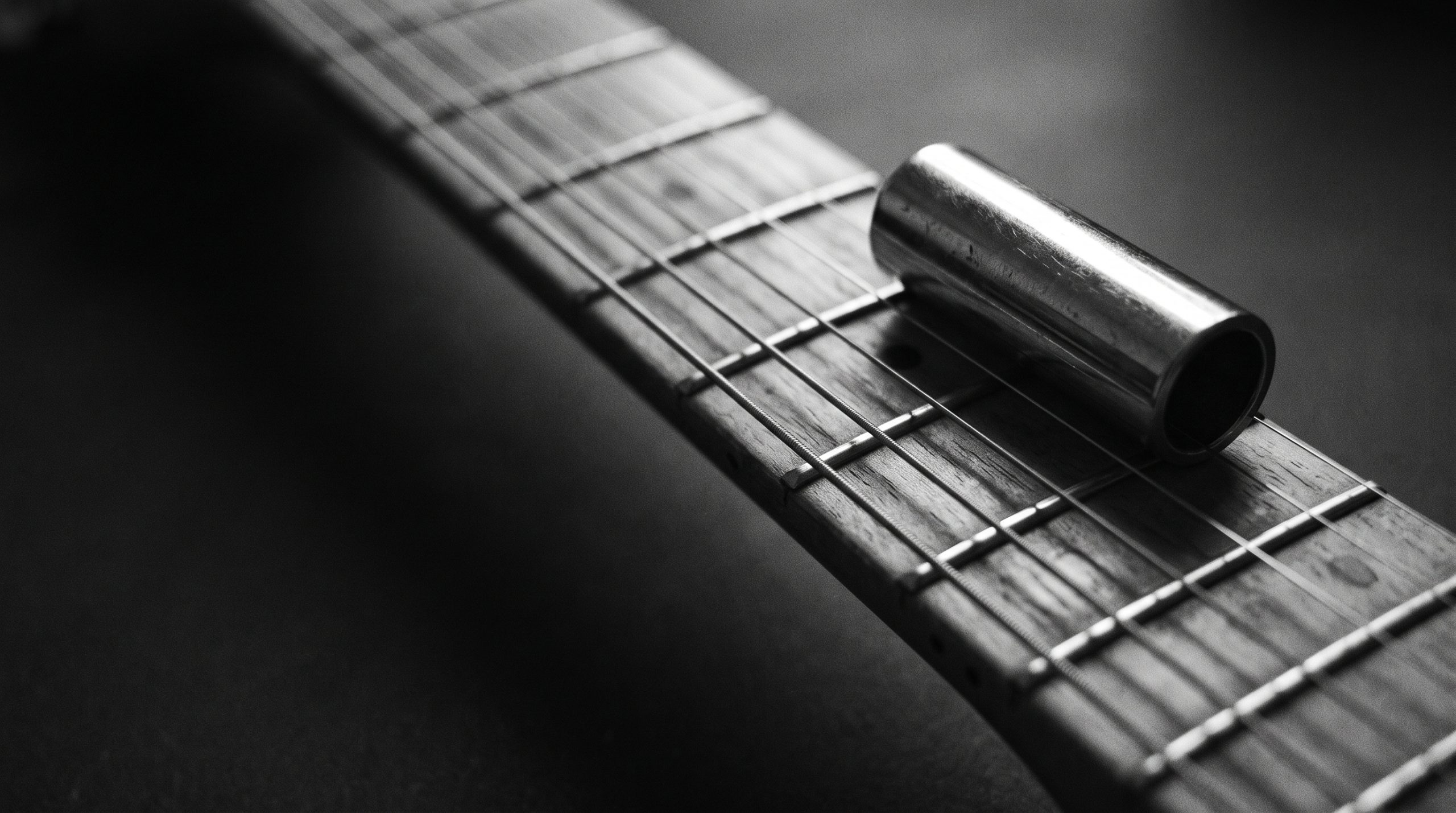
The open G assumption
Most slide lessons start the same way. Retune to open G, or open E, or open D, and drag the slide straight across the strings. It works, and it sounds great. It also means you now own a guitar you don’t know how to play.
Every scale shape, chord shape and lick you’ve spent years learning moves when you retune. So you either keep a second guitar in an open tuning, or you retune mid-session and spend the next ten minutes playing like a beginner.
I think most blues players can skip that step entirely. You don’t need open G to play convincing slide. Most of what makes open G work is already sitting on your guitar in standard tuning. You just haven’t been shown where it is.
Open G is half standard tuning already
Here’s the part nobody points out. Put open G next to standard tuning, string by string:
Open G only retunes strings 6, 5 and 1. Strings 4, 3 and 2 (D, G and B) stay exactly where they are. Open E keeps the top two strings unchanged.
So a lot of classic open G slide playing happens on three strings you never retuned. What open tunings really give you is a full six-string chord under a straight slide. That matters if you’re playing solo acoustic Delta blues. In a band, with a bass player and a rhythm guitarist covering the low end, it matters much less.
Your open G chord: the D, G and B strings
Play the D, G and B strings open and you get a G major triad. Lay the slide across those three strings at any fret and you get a major triad there too. The root is always on the G string.
That gives you a 12-bar blues in A without moving more than a hand’s width:
- A (I chord): 2nd fret
- D (IV chord): 7th fret
- E (V chord): 9th fret
The classic move is to come in from a fret below and slide up into the chord:
To find the chord in any other key, find the root on the G string and lay the slide there. If you already know where the notes are on the G string, you already know where every chord is.
Two more chord sources: the top strings
The top two strings. The B and E strings are a fourth apart, the same as in open E. Barred together, they give you the 5th and root of the chord whose root is on the high E string. In A, that’s the 5th fret for A, the 10th for D and the 12th for E. That two-note sound is the backbone of a lot of electric blues slide, and you get it without retuning anything.
The G and B strings. These are a major third apart. Barred, they give you the root and 3rd of the chord whose root is on the G string. At the 2nd fret that’s A and C#, the sweetest-sounding pair on the neck.
The top three strings. G, B and E together make a minor triad, with the root on the high E string. That’s your minor blues sound: A minor at the 5th fret, D minor at the 10th, E minor at the 12th.
Open G gives you one chord shape under the slide. Standard tuning gives you three or four, depending on which strings you pick.
Single-note lines: the pentatonic you already know
This is the biggest advantage of standard tuning, and it’s not close. Your minor pentatonic shapes don’t move. The A minor pentatonic box at the 5th fret is still the A minor pentatonic box. You just play it with a slide instead of your fingers.
A few things change:
- Slide into notes rather than landing on them. Approach from a fret or two below. The glide is the sound.
- Stay on one string longer. With fingers you’d cross strings to the next note. With a slide, it often sounds better to travel along the string to get there.
- Favour the top three strings. That’s where slide sounds most vocal, and where muting is easiest.
- Use the b3 to 3 move. Sliding from C to C# on the G string (5th to 6th fret in A) is the most blues-sounding fret on the neck.
That lick is three notes from the pentatonic box you learned years ago, plus one major 3rd. Nothing about it requires a retune.
The real catch: muting
I won’t pretend standard tuning is free. In open G, a stray string rings in tune with the chord. In standard, it rings against it. So muting matters more.
- Fingers behind the slide. Wear the slide on your ring finger or pinky and rest the free fingers lightly on the strings behind it. That kills the ringing on the wrong side of the slide.
- Pick-hand muting. Rest the side of your palm or your spare fingers on the strings you aren’t playing. Fingerpicking makes this much easier than a pick, because each finger covers its own string.
- Light touch. Don’t press the slide down to the frets. It should just sit on the strings.
- Play over the fret wire. The note is directly above the fret, not between frets where you’d normally put your finger.
None of this is extra work peculiar to standard tuning. Good open-tuning players do all of it too. Standard tuning just punishes you faster when you don’t.
You’d be in good company
Standard-tuning slide isn’t a compromise for people who can’t be bothered to retune. Plenty of the players people copy did it this way.
- Warren Haynes took Duane Allman’s open E style and played it in standard tuning (Premier Guitar).
- George Harrison was mostly a standard-tuning slide player (Premier Guitar).
- Muddy Waters used open tunings early on but leaned towards standard in the ’70s and ’80s (Premier Guitar).
- Ariel Posen and Charlie Starr of Blackberry Smoke both prefer standard (Guitar World).
- Robert Nighthawk and Mick Taylor are usually named in the same lineage.
When open G is still worth it
There are times I’d still retune. Open tunings win when you’re playing solo acoustic and need the whole guitar to ring as one chord. They also win for Delta-style playing where the open bass strings drone under everything, and for songs that were written in an open tuning and don’t sound right without it.
If that’s most of what you play, get a second guitar and leave it in open G. For everyone else, playing electric blues with a band, standard tuning covers nearly everything. You also get to keep every lick you already know.