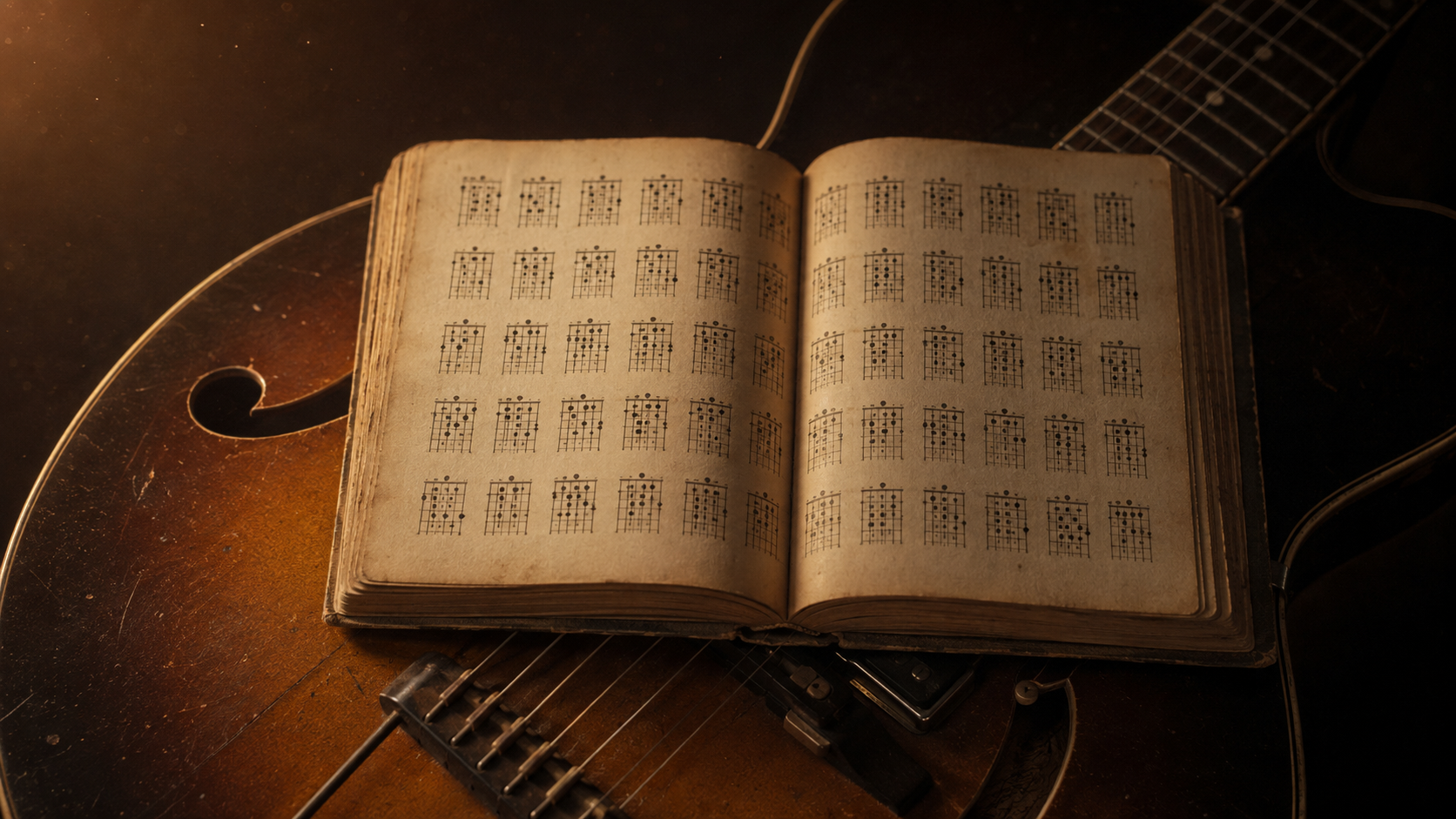
I’ve owned Ted Greene’s Chord Chemistry for about thirty years. I’ve opened it maybe forty times. I have never once come away from it with a chord I went on to use.
That’s not a review, it’s an admission, and I’d assumed for most of those thirty years that it was a personal failing. It isn’t. It’s the predictable result of using a book for something it was never built to do — and the giveaway has been printed on the thing the whole time.
What it actually is
Chord Chemistry first came out in 1971 and runs to a little over a hundred pages. Alfred, who publish it now, describe it as the classic chord reference book for two generations of guitarists.
Reference book. Their words, on the sales copy, right there. Not method, not course, not system.
The contents back that up. There are around twenty sections, and they cover an enormous range — fingerboard charts and string relationships, chord formulas and families, essential chords and their synonyms, polytonal chords, ear training, moving chords by fourths, substitutions, dominant sevenths and the cycle, voice leading, chord melody, triads, harmonies built from scales, blues progressions, rock progressions. The single largest chunk of it is the chord reference charts themselves.
It’s dense in a way that’s hard to convey if you haven’t held it. Small print, hand-drawn grids, minimal white space, page after page. It’s an extraordinary document. It’s also, unmistakably, a lookup table with essays wrapped around it.
Why it defeats people
You can’t practise a reference book. That’s the whole of it, but it’s worth taking apart, because the failure has three separate causes and only one of them is obvious.
There’s no sequence. No chapter one leading to chapter two. You’re expected to arrive with a question, find the answer, and leave. If you arrive without a question — which is what happens when you buy it because everyone says you should — there’s nothing to do. You leaf, you admire, you close it.
Lookup doesn’t build vocabulary. This is the part that took me far too long to see. When you meet a chord as an entry in a list, you meet it with no reason to want it. Nothing about the page tells you when you’d reach for that voicing rather than the one above it. You can memorise the grip and still never play it, because playing it requires a musical situation that calls for it, and the book has deliberately stripped all situations out in order to be comprehensive. Comprehensiveness and usability are trading against each other, and a reference book correctly picks comprehensiveness.
The teaching is hidden inside the reference. There is real instruction in there. The voice leading material is genuinely good. So is the section on substitutions, and the chord melody material. But it sits interleaved with hundreds of pages of grids, and nothing marks which pages are teaching and which are lookup. So people open it at random, land on a wall of diagrams, conclude the whole book is a wall of diagrams, and shelve it.
Add those together and you get the thing that actually happens: a revered book, owned by almost everybody, worked through by almost nobody, generating a quiet background hum of guilt in guitarists who assume everyone else cracked it.
Nobody cracked it. It’s a dictionary. You didn’t fail to read the dictionary.
What was actually missing
Here’s the reframe that finally did something for me, and it has nothing to do with Ted Greene.
I didn’t need more chords. Thirty years in, I already owned far more voicings than I was using — which is the normal state of affairs for anyone who’s been playing a while. What I was missing was a reason to choose one.
That’s an organisational problem, not a knowledge problem. And every chord book I owned, Chord Chemistry included, was organised the same way: by root and chord type. All the C chords, then the C sharps. Which is a sensible way to print a book and a useless way to play one, because the root is the note nobody hears. The bass player has it. It sits in the muddiest part of the range. Your listener worked out the chord a bar ago and moved on.
What a listener actually follows is the top note. It moves like a melody, and everything under it gets heard as accompaniment to that melody. It’s why two players running the same progression can sound like two different musicians while analysing identically on paper.
Try it before you take my word for it. Play a C major chord — any one you like. Now play another C major with a different note on top. Same harmony, same symbol on the chart, completely different musical statement. Nothing about the theory changed. Everything about the sound did.
If you heard that, you’ve just located the thing that was missing from thirty years of chord books.
A free way to see the structure
The reason lookup fails is that a chord diagram shows you a result with the reasoning removed. You get six dots and no account of what they are.
I built a chord builder that works the other way round. You add one interval at a time and watch the chord assemble, and you finish with the structure laid out across the whole fretboard rather than as a single grip — which means you can see every chord tone available to you, including which ones you could put on top. It’s free and there’s no sign-up. If the top-note idea above landed, half an hour with that will tell you whether this way of thinking suits you before you spend anything.
What to do with your copy
Keep it. I’m not telling you to get rid of a book I’ve owned for three decades and won’t be parting with.
Use it as what it is. When you have a specific question — what are my options for a 13#11, what’s a synonym for this shape — it’s excellent, and faster than the internet. That’s a real use and it justifies the shelf space on its own.
And read the voice leading and substitution sections as prose rather than as reference. They’re the parts where Greene is teaching rather than cataloguing, and they’re worth more than the hundred pages of grids that surround them.
What I’d stop doing is treating it as homework. It was never an assignment. It’s a dictionary written by someone with an extraordinary ear, and it does what dictionaries do.
About Greene
None of the above is a criticism of the man, and it would be a poor reading of him to take it that way.
Ted Greene was, by every account of anyone who sat with him, a remarkable teacher — and he taught in person, by ear, responding to whoever was in front of him. That’s the exact opposite of a lookup table, and it’s the part the book structurally cannot contain. What got printed is a record of what he knew. Knowing something and having a route to knowing it are different things, and only one of them fits between two covers.
After his death his students and family put a large archive of his lesson material online, free, at tedgreene.com. If you want the teaching rather than the reference, that’s closer to it than the book is.
The short version
You don’t need more chords. You almost certainly have more than you’re using right now, sitting unused because nothing in the way you learned them told you when to reach for one.
That’s what Chords from the Top does — it re-files the chords you already own around the note people actually hear, rather than the note they don’t. It isn’t a dictionary and it won’t hand you fifty new shapes. It’s the organising principle I spent thirty years not finding in books that were never built to supply one.
Start with the free chord builder if you’d rather test the idea first. Either way, take the guilt off the shelf along with the book.
If the problem is that you own plenty of chords and no reason to reach for one, this is the organising principle that fixes it.
No Shapes: The Interval Method
Everything on the guitar from one note. One shape to memorise, one interval map, and a list of formulas — no boxes and no diagrams anywhere in the book.
ONE STRING UP
Part of the map the whole book runs on. Three rows, one exception.