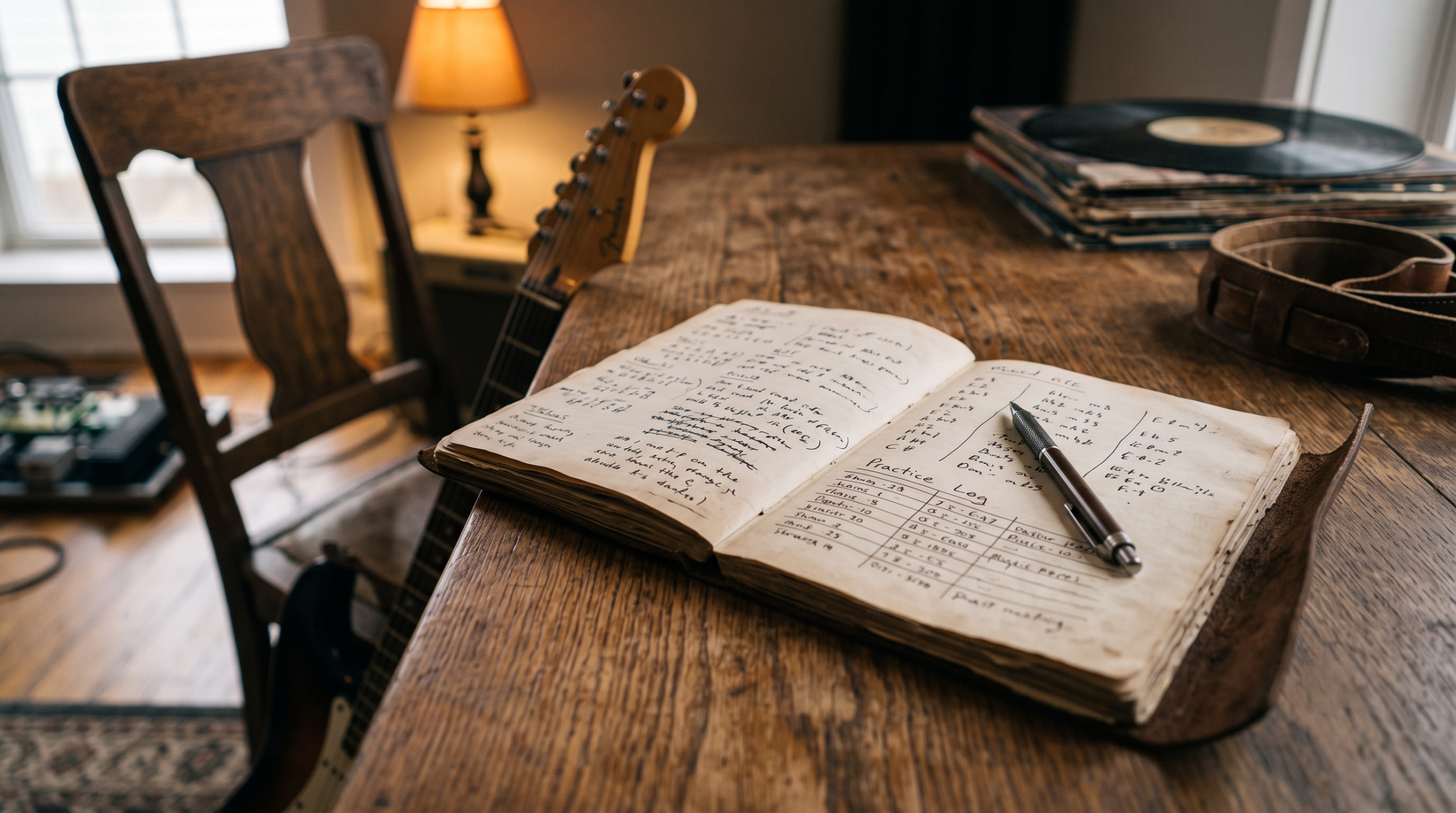
Most articles on this topic tell you the same thing: keeping a journal helps you “stay motivated” and “track your progress.” True, but vague enough to be useless. Motivated to do what, exactly? Tracked how?
Here’s what a practice journal actually does, mechanically, if you build it right.
It turns vague practice into specific practice
“I practiced guitar for 45 minutes” tells you almost nothing. “I practiced Dorian shapes over a ii-V-I at 80bpm and got clean at 100bpm” tells you exactly what happened and exactly what to check next time. The difference isn’t motivation — it’s specificity. A journal forces you to name what you actually worked on instead of letting a practice session dissolve into a vague memory of “I played guitar today.”
It exposes what you’re actually avoiding
Everyone has a section of their playing they quietly skip. Ear training. The one scale that still trips them up. The thing that’s slightly boring. Without a written record, avoidance is invisible — you just don’t notice weeks going by where you never touched it. A log makes the gap visible, because eventually you’re staring at three weeks of entries that all say the same thing, or conspicuously don’t mention something you know you should be working on.
It gives you an actual answer to “am I improving”
Guitar players plateau, or feel like they have, more often than they actually do. The problem is usually that improvement is too gradual to notice day to day. A journal with dated tempo checkpoints, or a repertoire log with dates next to each thing you’ve learned, gives you something concrete to look back at. Six weeks of entries showing a tempo climb from 70bpm to 110bpm on the same lick is proof, not a feeling.
It turns practice into a system instead of a mood
Practicing “whatever I feel like” some days and nothing on others is normal, but it’s also why progress feels random. A journal — even a simple one — pushes you toward naming a current focus and returning to it, rather than restarting from scratch based on whatever you’re in the mood for that day. This matters more the less time you have to practice: an adult with 20 minutes a day benefits far more from a structured, dartboard-focused 20 minutes than an unstructured hour.
It’s where cross-system connections actually get noticed
If you’re learning from more than one book, method, or teacher — which most intermediate players eventually are — a journal is the only place where you’re likely to notice when something from one system connects to something you already learned in another. That kind of connection is exactly what turns disconnected technique into actual musical understanding, and it rarely happens by accident if nothing’s written down to prompt the comparison.
What most practice journals get wrong
Most of what’s sold as a “practice journal” is a blank box for every day of the year — nothing telling you what to actually focus on, no structure connecting one week to the next. That’s a diary, not a system. The benefits above only show up if the journal actually has structure: a place to name your current focus, a recurring review point (not just a running log with no checkpoints), and specific trackers for the things that actually move the needle — tempo, repertoire, ear training — not just a generic “what I practiced today” field.
That’s the gap The Guitar Practice Journal is built to fill — free to download, with a pay-what-you-want option if you find it useful.