
Ask the internet what scales Allan Holdsworth used and you’ll get three kinds of useless answer.
The first is “everything” — technically true, completely worthless. The second is “he just played chromatically” — wrong, and a lazy way of saying “I can’t hear what he’s doing.” The third, usually from someone quoting a half-remembered interview, is “he didn’t think in scales at all.” That one’s the most interesting, because it’s almost right and still misses the point.
So let’s do the thing nobody else seems willing to do: actually answer the question. Which scales, what he did with them, and — the part everyone gets wrong — why it comes out sounding smooth and alien at the same time instead of like a man falling down the stairs.
The short answer (because you came here for one)
Holdsworth leaned heavily on a small handful of sounds, not a giant grab-bag:
- Melodic minor and its modes. This is the engine room. Most of the lush, “where am I exactly?” Holdsworth color comes from melodic minor harmony — especially the altered scale (the 7th mode) over dominant chords and Lydian dominant (the 4th mode) for that bright, floating, unresolved thing he loved.
- The diminished scale. Symmetrical, deliberately ambiguous, no home key to anchor you. Perfect for someone who didn’t want the listener to feel a gravitational centre.
- The whole tone scale. Used sparingly, but it’s there — that weightless, keyless wash with no semitones to grab onto.
- His own scales. And here’s where it gets honest: a chunk of what he played doesn’t sit cleanly in any scale you were taught. He built his own, by ear, and treated them as legitimate sources to draw from.
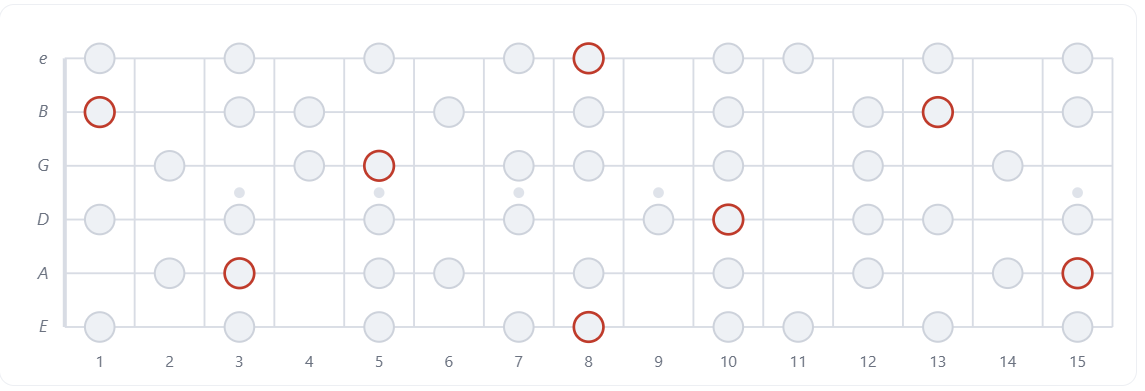
If you stopped reading right here, you’d already know more than 90% of the “Holdsworth used every scale” crowd. But you’d still be missing the thing that actually matters, which is this:
He thought about scales backwards
Here’s the bit the forums fumble. Most of us are taught chords first, then we learn which scale “fits” on top. Chord comes in, you reach for the scale that matches it. Scale serves the chord.
Holdsworth ran it the other way round. The scale came first, and the chords were pulled out of it.
He’d settle on a scale he liked the sound of — one of his own catalogue of them — and then harmonize it, stacking notes to build voicings that lived inside that scale. The chords weren’t the starting point he decorated. They were a by-product of the scale. That’s why his comping sounds like nothing else: those wide, unfamiliar voicings aren’t “a Cmaj7 with extensions,” they’re slices of a scale, frozen and played together.
Once that clicks, the whole “what scales did he use” question reframes itself. He wasn’t matching scales to chords in real time. He was living inside a scale and improvising both the lines and the harmony out of the same pool of notes. The scale is the key centre, the chord, and the melody, all at once.
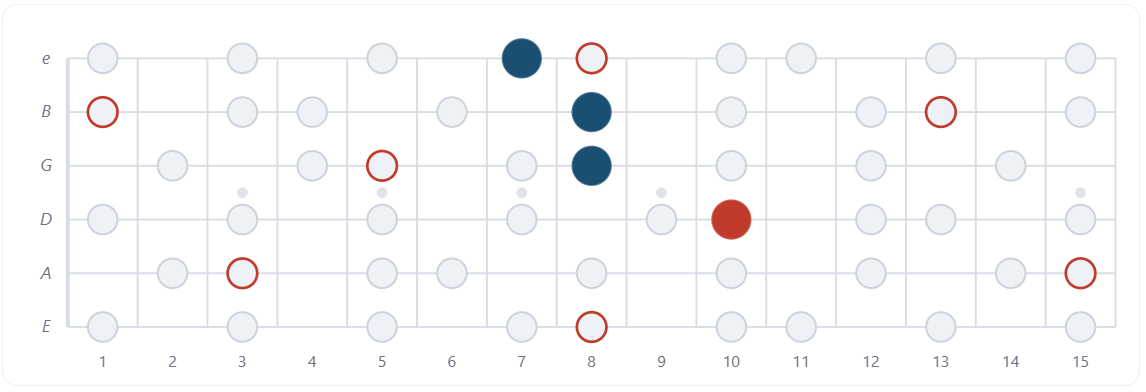
Image taken from the free Holdsworth Chord Explorer tool–try it out for yourself!
That’s also why “he didn’t think in scales” is half-right. He didn’t think in scales the way you do — as something you switch between to chase passing chords. He thought in scales as whole worlds you inhabit.
So why does “outside” sound smooth instead of wrong?
This is the real question, and it’s got almost nothing to do with the scales themselves.
You can hand someone the altered scale and the diminished scale and they’ll sound like they’re soloing over the wrong song. Holdsworth used the same raw material and it sounds like silk. The difference isn’t note choice. It’s everything around the notes:
1. No attack. That legato, picking-almost-nothing approach isn’t just a technique flex. A picked note has a hard percussive front edge — it announces itself. When you play an “outside” note with a sharp attack, the ear flags it as a mistake. When it arrives by hammer or slide, with no spike, it glides in under the radar. The same out-of-key note feels like a color instead of a collision. He made tension enter quietly.
2. Wide intervals hide the scale. Run a scale straight up in steps and the ear instantly clocks it — “ah, diminished, I hear the pattern.” Holdsworth leapt. Big stretches, fourths and wider, so you never hear the ladder, only the destinations. Strip out the stepwise motion and the scale stops sounding like a scale and starts sounding like intent.
3. He resolved. The outside stuff always went somewhere. Tension that lands feels deliberate; tension that just sits there feels like a wrong turn. He’d push out into the strange scale and then resolve it home so cleanly that your ear forgave — even thanked — him for the detour.
4. Horn brain, not guitar brain. He wanted to sound like a saxophone or a voice — one continuous breath, not a series of struck strings. That phrasing instinct is doing as much work as any scale. The “Holdsworth sound” is a phrasing sound that happens to use exotic scales, not an exotic-scale sound that happens to be phrased well.
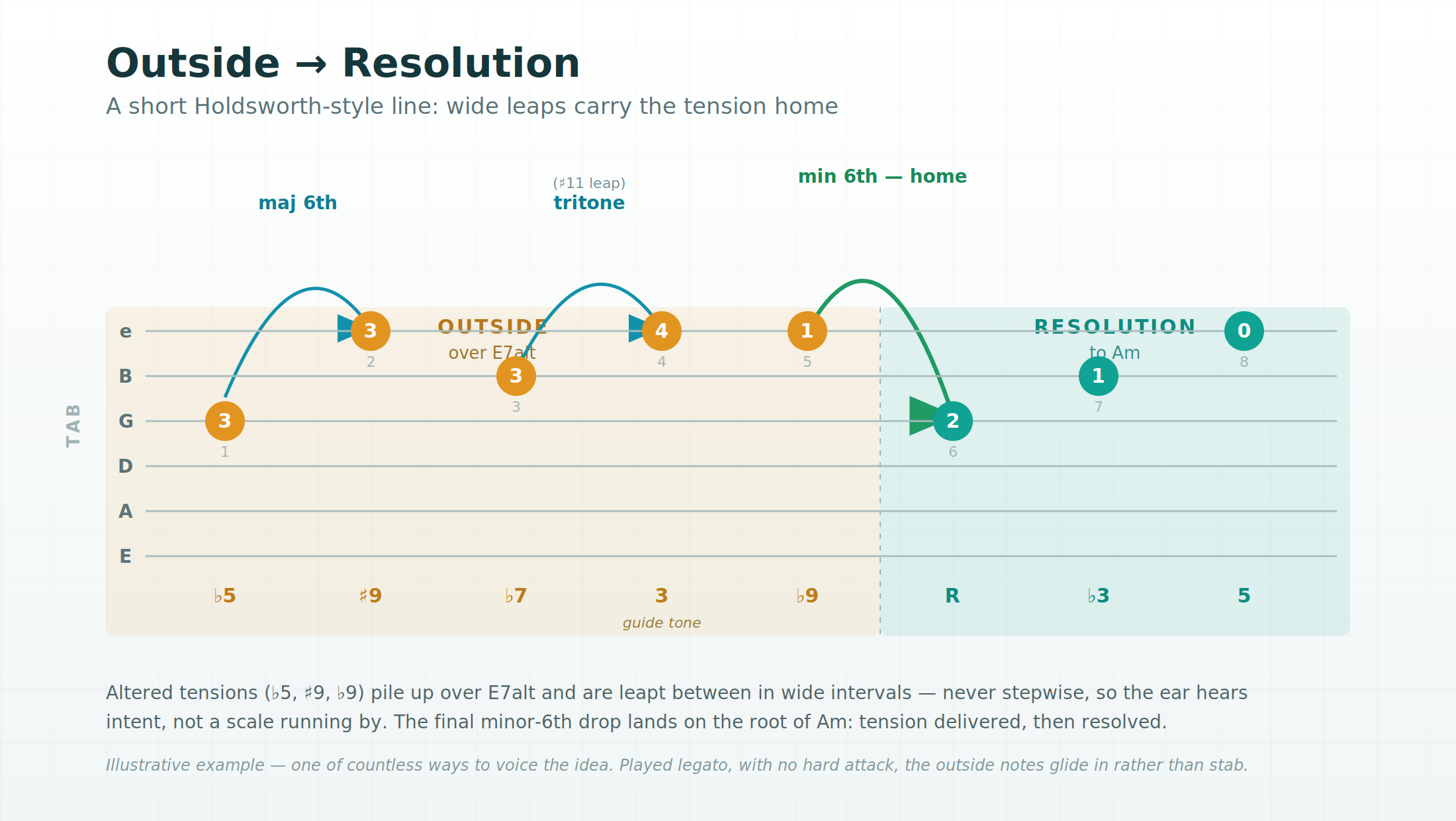
Put those four together and you’ve got the actual recipe. The scales are maybe a quarter of it. The other three-quarters is how the notes are delivered. This is why guitarists who memorize his scales still don’t sound remotely like him — they copied the paint and ignored the brush.
How to actually start using this
Don’t go chasing all of it at once — that way lies the usual Holdsworth despair, where you decide he was a wizard and give up. Start narrow:
- Take one scale — melodic minor is the highest-value place to begin. Learn it as one connected shape across the whole neck, not five disconnected boxes. If you want the mechanics of laying a scale out that way — the actual four-notes-per-string patterns Holdsworth favored — I covered that in detail in An Introduction to the 4NPS Scale System. Think of that article as the “how to play it” half and this one as the “what to play and why” half.
- Practice pulling chords out of it rather than playing it as a line. Stack notes from the scale and listen to the voicings you get. This is the backwards-thinking muscle, and it’s the one nobody trains.
- Then play lines over those voicings using only that scale, and work on legato and resolution before you worry about going outside at all. Get it smooth first. The “outside” takes care of itself once the delivery is right.
That’s a month of genuinely useful practice from a single scale, and it’ll teach you more about Holdsworth than memorizing his entire scale list ever would.
Where to go from here
If you want the whole map rather than one scale at a time, that’s exactly what I wrote Allan Holdsworth — A Guitarist’s Guide for. It lays out Holdsworth’s harmonic approach as a system you can actually use — the scales he drew from, how he built chords out of them, and how the whole thing connects across the neck — without the mysticism and without needing to transcribe forty years of solos yourself to find the pattern.
It’s one of the few books I’ve seen that treats his approach as learnable rather than magical, the reviews on Amazon are kind, and at the price it’s a fairly painless impulse buy if you’re a Holdsworth fan who’s tired of vague answers.
You came here wanting to know which scales he used. The honest answer is: a small set of them, thought about backwards, and delivered so well that the scales almost stopped mattering. Start with one, get the delivery right, and you’ll hear it for yourself.