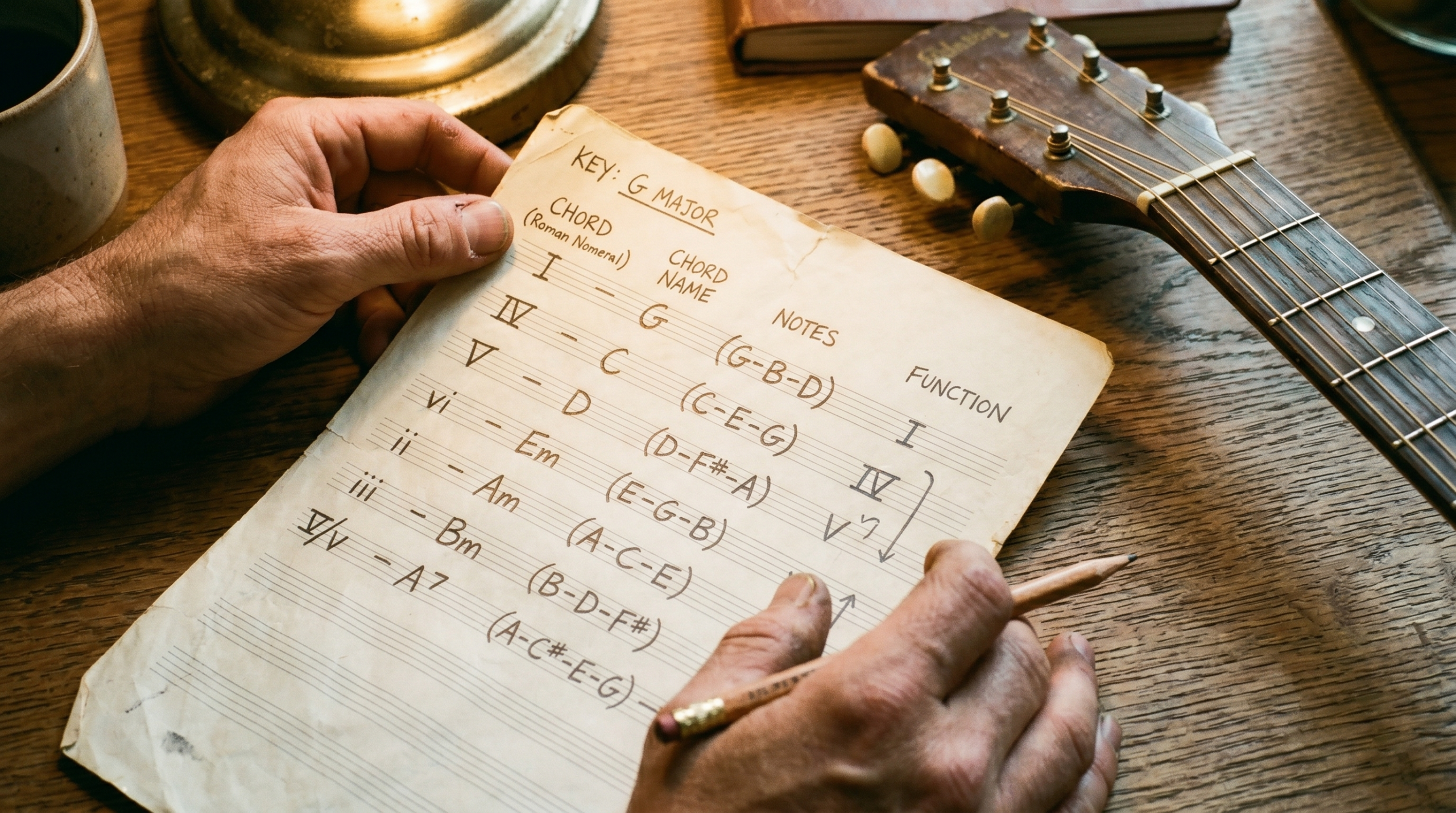
Diatonic chords and chord progressions are those that belong to a certain key. We can say a chord progression is diatonic when it uses chords from one key. For you to be able to recognize this, you need to know which chords belong to which keys. Here’s a handy reference chart to help you:
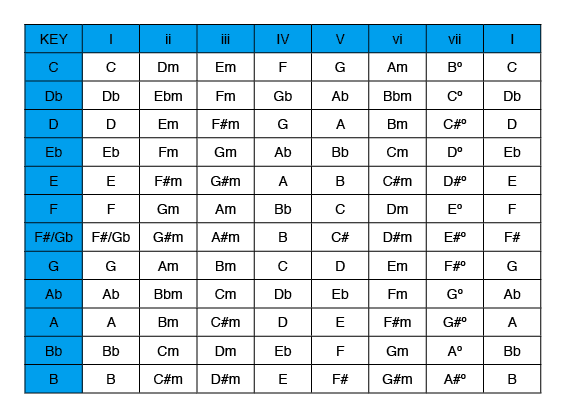
Let’s look at a couple of examples.
If you have a progression such as:
Am | Dm | Em
Your go-to scale choice would be A Natural Minor/A Aeolian because these three chords are diatonic to the key of A Minor (C Major):

Here are the same chords starting from Am as A is now the root:

Playing the A Natural Minor scale over these three chords is the safest way to improvise, BUT… you could also play A Dorian, D Dorian, then E Dorian, or mix and match any other minor scales you like. You’ll have to work a little more at this to get it to sound good but it’s well worth it and will allow you to experiment with far more harmonic possibilities. Bear in mind that your improvisation needs to be appropriate for the style of music you’re improvising over. For the above progression in a pop/rock setting, you’ll probably want to stick to the A Natural Minor scale as it’s the most inside sounding (safest) solution. However, if you the same chord progression came up in a jazz or fusion setting, mixing in other scales definitely won’t sound out of place.
If you’re used to blowing over this type of progress with a minor pentatonic scale, here’s why it works:

All I did was remove two notes from the A Natural Minor scale to get the A Minor Pentatonic scale, which includes our three minor chords.
So, when you’re confronted with a chord progression to solo over, analyze it using the following steps:
1. Identify chords or sequences of chords that are diatonic and identify the key to which they belong.
2. Identify the chord the tune resolves to – this will tell you which diatonic scale to use over the progression.

For example, if we have a progression that goes from F to G, we can solo over it using F Lydian. If our progression were Em to G, we could use E Phrygian etc.
Great, now I need to learn the modes
Not really because when you’re dealing with a diatonic progression such as the F – G one, as long as you know where the notes are in C Major, you can improvise over it only the F will sound like the ‘home’ note rather than the C. What I’m saying is that you’re going to use the same set of notes but start from a different one; it’s not necessary to call it a mode at this point.
Non-Diatonic Chord Progressions
Non-diatonic chord progressions are those tricky sequences of chords that either don’t belong to one key, change key, or contain one or two rogue chords from other keys. Let’s say we have a chord progression that goes from Gm7 to Ebm7. If you check the table at the beginning of this post, you realize that these two chords don’t belong to the same key. As there are three minor chords in every key, they could belong to any of those, but this doesn’t really help us decide what to play over them. In this situation, you have free rein to decide which minor scales to use, although a good place to start would be G Dorian to Eb Dorian; from there you can experiment with other minor scales.
For now, learn which chords belong to which keys using the reference chart above — it’s the foundation for everything else. Once that’s solid, chord tone soloing takes this analysis a step further, showing you how to target specific notes within each chord as it moves rather than just picking a scale for the whole progression.
If you want a complete system for understanding diatonic harmony in the context of the CAGED framework — chords, arpeggios, scales and modes all connected — Hacking the CAGED System: Book 1 covers this ground in full. And for working out what key any chord progression is in before you start, the free What Key Am I In? app does the analysis for you instantly.”